
A Guide to Healthy Aging From Gerontology Nurse Practitioner Experts
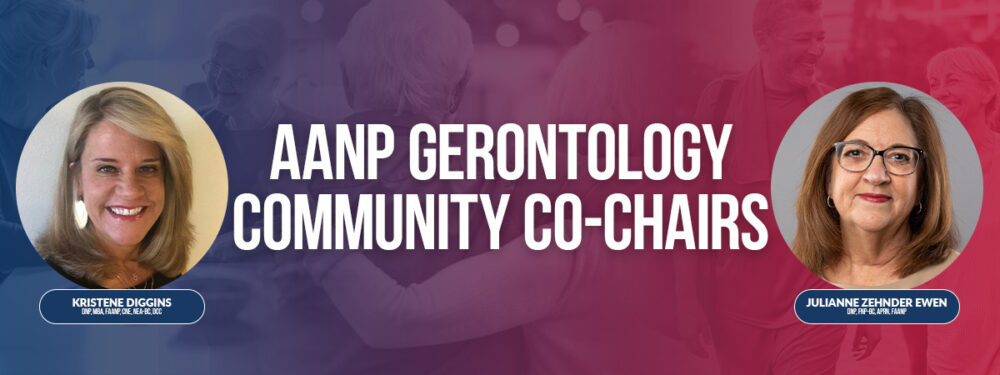
The co-chairs of AANP’s Gerontology Community share how patience and high-quality holistic health care guide their practice.
The United States Census Bureau projects that “The share of the world population age 65 and older is projected to nearly double from 10.5% to 19.6% between 2025 and 2060,” and that “By 2060, older adults are projected to make up 23.4% of the U.S. population.” As our population ages, more nurse practitioners (NPs) will be needed to provide the unique care these aging patients require. Fortunately, gerontology as a specialty is growing, and NPs who have joined this specialty have found that it includes unique challenges and rewards — and that it can even be a lot of fun.
The American Association of Nurse Practitioners® (AANP) spoke with Julianne Zehnder Ewen, DNP, FNP-BC, APRN, FAANP, and Kristene Diggins, DNP, MBA, FAANP, CNE, NEA-BC, DCC, the co-chairs of AANP’s Gerontology Community, about why they find working with older populations so rewarding. They also provided insight into why NPs may want to consider specializing in gerontology and how our aging country (and our aging selves) can stay active, alert and healthy in our golden years.
Early Guidance Makes a Difference
For Diggins, her path into gerontology was guided by both professional and personal mentors. “I have been mentored throughout most of my career,” she says. “But then I had an NP who mentored me, and her approach to patient care — especially because she worked with older adults — really stood out to me.” In particular, Diggins noted her mentor’s “full holistic approach to caring about the patient,” which included making sure to “involve family as much as possible in a patient’s care plan.” Even before she decided to become an NP, Diggins had been close with her grandmother, describing her as “somebody who was really influential in my life.”
Diggins found that she enjoyed interacting with her grandmother and with other older individuals, and as a professional, decided to become an advocate for this patient population. “Older adults are vulnerable,” she says. “I don’t want to compare them to children, but the truth of the matter is that this is a vulnerable population that doesn’t have a voice. What might make you interested as an NP in this specialty is that you start to realize that somebody’s got to be a voice for these people.”
Ewen began her career as a pediatric nurse, and — like Diggins — sees connections between both specialties. “Pediatrics is not that vastly different from geriatrics,” she says. “You’re dealing with bigger doses, but your patient population is somewhat the same, really. You’re dealing with parents as a pediatric nurse, and you’re dealing with children of parents as a geriatric nurse.”
After five years as a pediatric nurse, Ewen went back to school and became a family nurse practitioner (FNP). As an FNP, she worked for years with the same patients, caring for them as they aged. “My population as an FNP was getting older, and that pushed me towards learning more about the geriatric population,” she recalls. “I was also having to deal with dementia in my own family, so that also sort of pushed me towards learning more about dementia.”
This desire to become a subject matter expert and to better care for her own family had an unexpected benefit for Ewen, as she found she really enjoyed the experience of caring for older patients. “It’s a fun world,” she says. “The information that patients bring to you in this world is so much more fun than what you were learning before. I mean, you learn so much more history, you learn so much more about the life of that patient than you were learning before.”
Taking the Time
One challenge when it comes to working with an aging population is the necessity of having conversations that many patients are not eager to have — about plans for end-of-life care, including discussing when to consider hospice care, for example. But it’s possible to do so, says Diggins, and everyone can benefit from the openness and dialogue. “First of all, be patient,” she advises. “We’re so used to, ‘Okay, let me treat your sinus infection with this antibiotic and you’re going to get better.’ It’s relational, and this patient population is very challenging to take care of if you don’t have time to build a relationship.”
Diggins also recommends that NPs ask open-ended ended questions — and then make sure to really listen to the answers. “Come at it with a curious mindset, but then appreciate that it’s time-consuming…and that’s okay. It can be awkward, and most people aren’t going to want to have that conversation with you on the first visit. But as you get to know them and they trust you, you’re going to be a safe place,” Diggins says.
Both co-chairs also stress the importance of listening to the patient about their wishes, and really hearing what they want as opposed to what others imagine is best for them. Diggins credits her NP mentor in helping her wade through discrepancies between what a patient says they want and what a patient’s family, for example, believes the patient wants. “One of the challenges that I didn’t realize until my NP mentor helped me — and now looking forward in my own patient panel — is that families often get in the way of patients’ wishes. Families will be outspoken about a patient’s wish, and [the patient] might be completely able to advocate on their own — but the adult children are saying what it is [the patient] wants.”
Ewen concurs and says that “you have to act as [the patients’] advocate because oftentimes their children don’t want to face those changes and those decisions, and so you are the advocate. You’ve had those conversations; you know where that patient is coming from.” Ewen has had to act as an advocate not just around family, but also around other health care professionals, as well. “I’ve even had to have those conversations with their specialist provider. Your patient has decided, ‘I’m not going to have this surgery. I don’t want to prolong my life. I don’t want to run the risk of having the anesthesia that’s accompanying the surgery. I’ve recognized that I’m 80 years old and I don’t have quality of life anymore, and this potentially could make my life worse. I’m done.’ And the surgeon doesn’t want to accept that. I’ve had those conversations as well. You end up learning how to gracefully be the advocate, and be the forceful advocate for your patient — being the one that says: ‘Look, this is well-documented throughout their chart, that this is the path they want to take. They don’t want to have this surgery, and I recognize that they can’t really voice that for themselves right now, so I’m going to be their voice.’”
Allowing for Optimism…and Grief
One thing both co-chairs emphasize is the importance of being social and continuing to do the activities we love as we age. “If you give up activities that you really enjoy because you feel like you’re getting too old to do them, that’s not always the healthiest mindset,” says Ewen. “Adapting to what you like to do so that you can do it is a better mindset. If I can’t go for a 15-mile hike anymore, well, I can do a two-mile hike if it’s the right altitude and going along the right pathway.” She adds that, “my husband is 76 years old and still goes snowboarding. I mean, he goes to a different snow park that allows him to do slower runs or smaller runs. It’s easier on his joints and easier on his bones, and he takes one of my older kids. You adapt and change, but you still get out and do.”
While remaining positive is key to working with elderly populations, NPs who specialize in gerontology accept the reality that their patients are entering the final stage of life. When asked how she has been able to stay positive, even while experiencing loss, Diggins says that, “I don’t think that disappointment ever goes away. You do best by your patients. This morning I lost a patient that I’ve invested so much in, but I feel at peace. It’s no different than any other stage of life — you’re making sure that the patient is getting the best care, and that they’re being advocated for. I feel at peace with the fact that even though she passed, the way she passed was what she wanted, and that was at home with family.”
Diggins reflects that it’s important that “I let myself grieve. First, we’re humans, and I think we forget that as clinicians. So, I let myself grieve. I always do something…so with her, I wrote a note to her family, and it helps me process that. But I also know I’m not going to get cold, like ‘That’s just the way it is. Bring on the next patient.’ I love the challenge of staying emotionally healthy, and this job — this specialty — demands that.”
Join the AANP Gerontology Community Today
As a community member of AANP’s Gerontology Community, you’ll have access to a cutting-edge, online forum where you can engage in discussions, document sharing and knowledge exchange with fellow NPs. Come learn, share and help progress the development of theory and practice in gerontology.
AANP also has tools available related to treating older adults, including Cognitive Health in Aging: Early Recognition, Management, and Hope in Mid-Life and Beyond. Two continuing education activities are also available related to gerontology: Managing Complex Older Adults With Depression and CBT and Yoga for the Treatment of Late-Life Worry.