
All Aboard the Health Wagon: Meet the Nurse Practitioners Bringing High-Quality Care to Central Appalachia
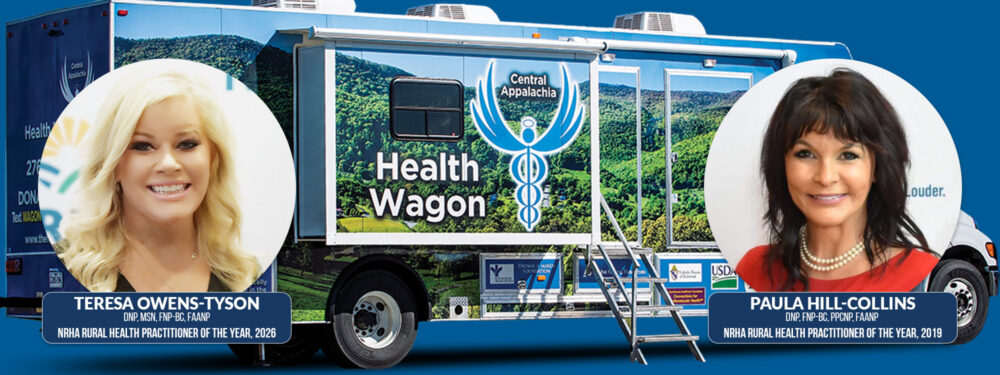
Drs. Paula Hill-Collins and Teresa Owens-Tyson speak about serving rural communities and what makes it all worth it.
While on the phone with the American Association of Nurse Practitioners® (AANP) to discuss her clinic on wheels, the Health Wagon, and her recent recognition by the National Rural Health Association (NRHA) as Rural Health Practitioner of the Year, Teresa Owens-Tyson, DNP, MSN, FNP-BC, FAANP, asks to reschedule the interview for a bit until she can find better cellular service. This is not out of the ordinary for this nurse practitioner (NP) — spotty signals, rough roads and more are just a few of the typical challenges that greet a rural health care worker. But Owens-Tyson — along with her best friend and clinical partner, Paula Hill-Collins, DNP, FNP-BC, PPCNP, FAANP — has made it her mission to bring whole-person care to wherever their patients are for over thirty years. When reception was clear, Hill-Collins and Owens-Tyson spoke to AANP about the story of the Health Wagon, being recognized by the NRHA and how technology is changing rural care.
On the Road to Better Health
This April, Owens-Tyson was honored by NRHA as Rural Health Practitioner of the Year for “her extraordinary impact on health care delivery in Southwest Virginia and across rural Appalachia.” In 2019, Hill-Collins was honored by NRHA with the same award, making it the first time in NRHA’s history where the principals of one organization were both recognized with the same honor. Sharing this recognition makes perfect sense, given that both women have been instrumental in one another’s lives for many years. “Paula and I have been best friends since we were 14,” recalls Owens-Tyson. Their educational journey began at the same high school, continued at East Tennessee State University for their undergrad and concluded with master’s degrees at the University of Kentucky and doctorate degrees at the University of Alabama.
The story of the Health Wagon itself, however, began before either NP was practicing. “Our organization was started 46 years ago when Sister Bernadette Kenny, a medical missionary from Massachusetts, came to Appalachia and began offering free medical care from the back of her donated Volkswagen Beetle,” relates the Health Wagon’s website. “The locals relied on Kenny for basic medical needs — referring to her simply as ‘Sister Bernie’ and the care she provided as ‘the Health Wagon.’”
After finishing nursing school, “I was Sister Bertie Kenny’s first employee,” relates Owens-Tyson. “I loved every minute of it. [Sister Kenny] was an NP, and she was a great mentor to Paula and myself.” Hill-Collins joined Owens-Tyson in working for Sister Kenny, and “we were just really so impressed with what she was able to do as an NP in a rural area,” Owens-Tyson recalls. “We had really found our calling…a lot of people think they have to go international to find their calling, but we really found it right in our backyard. We care for the people Appalachia with such passion, and it comes from us wanting to help our own people in the region.”
Caring for rural patients has its unique challenges, but both women feel guided by their faith and supported by their role as NPs. “We look at NPs being central to the model that we have,” says Owens-Tyson. “All of the things we’re involved in — like disaster relief and looking at the social drivers of health — we’re very immersed in that, and we feel that as NPs, we’re aligned differently than most.”
New Solutions to Old Obstacles
Both NPs have experienced the unique challenges thrown their way as part of practicing in rural Appalachia. “It’s very hard living in Appalachia, so I think that’s where the resourcefulness and thinking outside the box and the creativity comes in,” says Owens-Tyson.
Owens-Tyson and Hill-Collins have advice for NPs who see the same demographic of patients that they do. “One thing that I’d like to impress for those rural health care providers is that they have got to use and to learn different skillsets than what you would think, even those that are a crossover into subspecialty and specialty,” says Owens-Tyson. “If you don’t learn those skillsets like Paula and I have, patients die.” She further concludes that “we need to learn these advanced skillsets such as cystos (cystoscopies) and colpos (colposcopy) and other advanced procedures, because if you’re going to reach rural health, that’s what you have to do. You have all of these challenges. You’ve got the lack of insurance, the transportation, the provider shortages, poverty and long distances to care. All that plays into the reason that we have to think outside the box, so that we’re really addressing the whole person and the conditions that affect that person’s health.”
From a policy perspective, this means empowering NPs. Owens-Tyson and her team would like to see a change made to the U.S. Department of Education’s rule that redefines “professional degrees” to exclude NP programs — a decision that would make it more difficult for students studying to become NPs to access the federal loan funding they need to compete their education. Hill-Collins points out that “a lot of nurses are raising families. They’re the only breadwinner in the family, and they have to have those loans to go to school, and now there’s a cap on it. In a perfect world, I do wish that schools would lower their tuition, but that isn’t going to happen. It’s just going to cause an even deeper shortage — especially in our rural areas — because a lot of NPs, including myself, depended on those students' loans.”
Owens-Tyson adds that she didn’t have the financial resources at her disposal to attend nursing school without student loans. “My daddy was a coal miner. He's 85 now with black lung. I definitely depended upon the school loans to get through school,” she recalls. “At our 20th year, we had seen over 100,000 patients during our RAM Wise County annual three-day event (now known Move Mountains Medical Mission). That care would've never happened if it had not been for us starting our clinic.” When COVID first surfaced, she says, “we ended up seeing 36,500 patients that year. We infused nearly 7,500 with monoclonal antibodies and got the vaccination rates up. We actually had to go on the CBS Morning News and beg for vaccines for our coal miners, because they did not have access. The Health Wagon saw those patients and kept a region of a vulnerable population from being decimated by COVID. And so, going back, if we didn't get loans, we would not be doing what we are doing — the immense impact that we're making in Central Appalachia to turn around health care disparities.”
Join AANP’s Healthcare Technology Community
AANP’s Healthcare Technology Community offers a unique opportunity to interactively collaborate with colleagues who share interest or clinical expertise in health information technology. Come learn, share and help progress the development of theory and practice in healthcare technology.