
Developing Expertise in Occupational and Environmental Health
Are you passionate about Occupational and Environmental Health? AANP has a certificate program and community for just that.
Workers all across the United States work hard every day in settings as diverse as offices, farms and stores; factories, restaurants and construction sites. And in every workplace, those on the job need an advocate to ensure their worksite is safe, they are medically capable of performing their job and the environmental risks at their worksites are mitigated. These are a few of the many responsibilities of a nurse practitioner (NP) specializing in occupational and environmental health (OEH).
Jean Aertker, DNP, ARNP-BC, FNP-BC, FAANP, the first co-chair of the American Association of Nurse Practitioners® (AANP) Occupational and Environmental Health Community, describes OEH as “a unique field that draws from pure science, clinical science and research experiences to study the impact of the environment and workplace hazards on human health while investigating cause and effect to deliver sound evidence-based practice.”
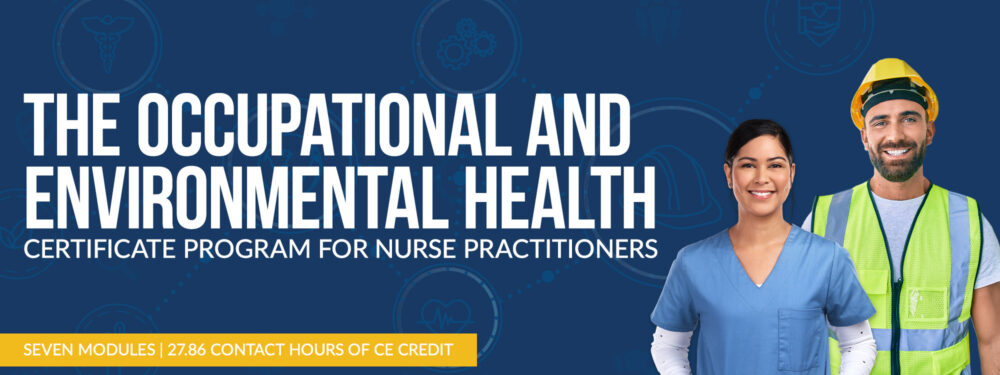
A certificate program is now available for NPs looking “to strengthen clinical competence, regulatory awareness and leadership skills in the care of working populations.” This resource, called the Occupational and Environmental Health (OEH) Certificate Program for Nurse Practitioners, contains seven modules on topics including workplace hazard recognition; injury evaluation and management; regulatory compliance; and much more — and offers up to 27.86 continuing education credit hours.
The original iteration of this certificate program was led by Maria C. Lanzi, MS, MPH, ANP-BC, COHN-S, FAANP; Sally Foster-Chang, DNP, ANP-BC, CRNP, COHN-S, CME; Melanie Hayes, DNP, APRN, NP-C; and Aertker. To help build the updated version of the program, Mary Fox, MSN, FNP-C, COHN-S, was brought on as a contributor, and the current project is led by Mary Fox, MSN, FNP-C, COHN-S, Lanzi and Aertker. Fox and Aertker were able to share with AANP their thoughts about the OEH program, and what they find so compelling about their specialty.
A Growing, Wide-Ranging Specialty
Aertker explains that while OEH is a smaller specialty, “occupational health nurses have been around since the turn of the century, working in industry, and have a long, storied history.” As to what drew her to make OEH her specialty, Aertker points to “the wellness part of it. Working with patients, working with employees to keep them well, keep them out of the hospital, keep them from getting sick or having exposures.”
She also notes that from her previous experience in the emergency room seeing patients suffering from on-site injuries, she was compelled to focus on preventive care. “We want to stop preventable injuries and deaths if we can. That’s a big part of occupational health — safety and safety concerns.”
A Refreshed and Relevant Certificate Program for All NPs
This updated OEH program, as Fox sees it, “is helping to get more NPs and advanced practice providers excited about the specialty, and how much autonomy and flexibility it can provide in terms of work-life balance as well as clinical experience.” Aertker also notes that “there are not many programs that get out there and teach you how to be an occupational health NP.” Although some states have Education and Research Centers (ERCs) where some NPs can earn a graduate degree, she continues, “ERCs are not in every state. I think the program that we put together is really helpful, to give this content to people who don’t have access.”
Centering Total Worker Health
As to what’s new, Fox mentions that the updated program includes “more case studies and more hands-on applications, and that really speaks to occupational health in general. It’s taking these very broad guidelines and regulations, and really drilling down: what does that mean in clinical experience, and how do we apply it?”
Fox also wants to make it clear that the “updated version [of the OEH program] was developed with the advanced practice provider (APP) identity in mind and is largely represented by leaders within the APP OEH community.” She continues by adding that “This module series helps demonstrate that we are here, we are practicing, we are caring for workers across all settings and we have meaningful expertise to share with the broader NP community.”
The program also highlights the concept of Total Worker Health, which, says Aertker, is a “new term, and not really well known across the United States, and even amongst some in occupational health.” Total Worker Health is best described as an approach to supporting worker safety, health and well-being across the working lifespan but emphasizing safter working conditions. Additionally, it’s more encompassing than a traditional employee wellness program — and it’s still evolving. Fox explains that “Total Worker Health is a foundational tenement because it’s more than just the work, it’s what’s happening both in and outside of the workplace, and how that’s impacting their ability to do the work that’s being asked of them. A healthy worker is a productive worker, which is also beneficial to the employer — it’s a very big win-win for both of them.”
NP leadership is also a concept explored in the OEH certificate program. “We want to touch on the need for leaders [in OEH] because it’s such a niche specialty,” says Fox. “There’s tons of leadership opportunities for someone who wants to learn, grow and then promulgate the specialty.”
As much room as there is to grow within the OEH specialty, both Aertker and Fox are clear that the OEH certificate program contains value for any interested NP. Fox notes that the program can be experienced as a whole, or NPs can choose what they will find most useful and go from there. “You don’t have to do the program in its entirely,” she says, concluding that “it can enhance your toolbox as a practitioner, and more power to you.”
Aertker, when asked to give her best pitch for the OEH certificate program, has an easy answer: “It’s convenient, it’s available, it’s affordable through AANP.” Fox, when asked if she wanted to add some final thoughts, shares that “I think the module series is great. I’m in awe of just how much experience is in this series, and I hope it benefits other people.”
Join AANP’s Occupational and Environmental Health Community
As an NP, you are often on the front lines for patients experiencing environmental health issues. AANP’s Occupational and Environmental Health Community offers a unique opportunity to interactively collaborate with colleagues who share interest or clinical expertise in these areas. Take part in interactive discussion and debate, gain support and explore Q&As and always be on top of the latest available news, education and information.