
Speaking About Lymphoma and Much More With an AANP Oncology Community Co-Chair
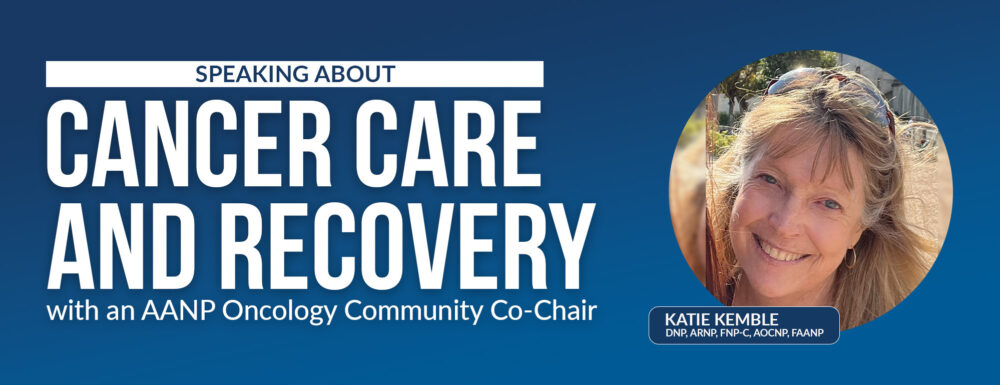
A nurse practitioner shares how she became both an oncology expert and an advocate for patients recovering from cancer.
The National Cancer Institute reports that in 2026, “roughly 2.1 million people will be diagnosed with cancer in the United States.” Behind this number are millions of individual patients, all who will need support from their health care providers during their initial diagnosis, treatment and recovery. Fortunately, more and more nurse practitioners (NPs) are stepping up to specialize in oncology, and the American Association of Nurse Practitioners® (AANP) is here to support oncology NPs with oncology and hematology resources and the AANP Oncology Community, co-chaired by Katie Kemble, DNP, ARNP, FNP-C, AOCNP, FAANP, and Susy Varghese, APRN, FNP, DNP.
Kemble is an academic, an entrepreneur and an expert in cancer care — but her path to specializing in oncology was anything but straightforward. Here, she speaks with AANP about what led her to become a specialist in oncology, and why she believes every NP interested in her specialty should join the AANP Oncology Community.
A Circuitous Route to Cancer Care
While she did not know it as she was studying to become an NP and earning her degrees, a tragedy early on in Kemble’s life would end up influencing her decision to ultimately specialize in oncology. “My mom died from lymphoma when she was 38, and I went to her funeral on my 17th birthday, which was a few days before Christmas,” Kemble shares. When beginning her career, Kemble “avoided oncology because of my history as a teenager,” she says, and instead pursued “wilderness medicine and climbing, emergency and critical care” in Colorado.
While the difficult experience of losing her mother so young made her momentarily shy away from oncology, a traumatic accident in 1989 realigned Kemble’s priorities. “I was out rock climbing, and my leg was hit by a rockfall that amputated my left lower leg. I had to carry my leg out of the mountain, and I was hospitalized,” she recalls. Kemble’s limb was saved, but for five months she was hospitalized at the Limb Preservation Institute in Denver, Colorado. As she recovered at the Institute and then learned to walk on her own again — a process that took over three years — she realized that “a lot of the resources I had to find for myself crossed over to cancer patients,” she says. “It was really a lot of quality of life. When you’ve had traumatic illnesses or accidents, there’s a lot of things that cross over.” She returned to work with a newfound focus and perspective, and left family practice to specialize in oncology.
The Necessity of Cancer Rehabilitation
Now working in oncology for more than twenty years, Kemble notes that her specialty is “always changing…it’s just a rapidly changing field with all the targeted therapies.” She recalls that when her own mother was diagnosed with non-Hodgkin’s lymphoma, “there was no chemotherapy — they had cobalt (therapy) for radiation. In April of 1971 she was diagnosed, and they told her she had just six months to live.” Today, thankfully, “the treatments have changed so much, and there’s always something coming down the line. I have no doubt that if she walked into a place now, she’d be fine.”
Treatments for lymphoma and other blood cancers are improving, and Kemble is also passionate about the opportunities to make positive changes in health policy related to recovery from cancer as well. “You’ve got cardiac rehab, you’ve got pulmonary rehab, you have stroke rehab — but do you think you have cancer rehab in the U.S.? We’re so far behind a country like Germany, where patients will go through cancer treatment, and then they go into 23 weeks of cancer rehab,” Kemble notes.
What Kemble would like to see is a structured cancer rehab, and she has been working to make this a reality for years. Quality of life is her primary focus, which means specific attention to sleep, cognition and exercise. She is striving to build what she calls “a coordinated cancer rehab program that covers everything,” which ideally would be covered by insurance and Medicare. While she feels new to the health policy arena and calls the process of learning “a very humbling experience,” she also knows there’s no downside to working for better care for patients. “Nothing ventured, nothing gained,” she concludes.
Join the AANP Oncology Community
Kemble, as co-chair of the AANP Oncology Community, has one thing she especially loves about her community. “The networking is fantastic,” she shares. “When you’re trying to do something like what I’m trying to do with cancer rehab, you don’t feel like you’re as alone. You can learn what other people are doing across the country. There’s strength in numbers.”
If you are an NP who is passionate about evidence-based medical, radiation and surgical oncology and who would like to engage with fellow NPs who share an interest in this vital specialty, the Oncology Community is an excellent resource for you. This AANP Community offers a unique opportunity to interactively collaborate with colleagues who share your interests and clinical expertise.